


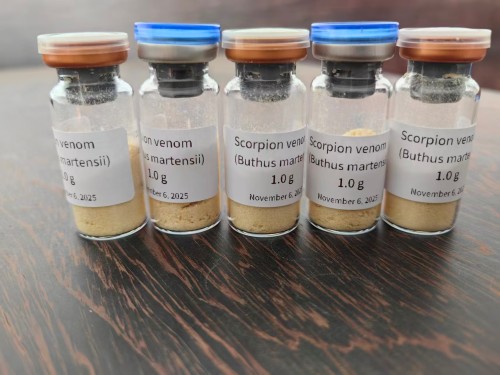


The venom of Buthus martensii (the Chinese scorpion) is a biotoxin characterized by complex components and diverse properties, with detailed elaborations as follows:
1.Source and Collection
Derived from Buthus martensii, a scorpion species under the family Buthidae and genus Buthus, this venom is predominantly distributed in Chinese provinces including Liaoning, Hebei, Shandong and Anhui. Venom extraction can be realized by inducing venom secretion from scorpions through approaches like high-frequency current stimulation or manual cephalothorax stimulation.
2.Composition
It is mainly composed of two fractions: proteins and non-proteins. The protein fraction acts as the primary active component, encompassing toxic proteins (scorpion toxins) and enzymes such as phospholipase A2, acetylcholinesterase and hyaluronidase. The non-protein fraction mainly includes lysine, trimethylamine, theobromine, taurine, glycerides, stearic acid, cholesterol and other substances.
3.Basic Properties
It possesses the general characteristics of proteins: its aqueous solution can be precipitated by ethanol, ammonium sulfate and the like, and will denature when exposed to strong inorganic acids, alkalis, ether and other organic solvents. The scorpion venom demonstrates relatively high heat resistance; it is not easily degraded by high-temperature boiling under normal pressure, and its toxicity remains largely unimpaired after heating at 100℃ for 30 minutes.
4.Toxicity and Poisoning Symptoms
It is a highly toxic substance, with an LD50 of 2.4 mg/kg via intraperitoneal injection in mice. In humans, a sting from Buthus martensii typically results in local redness, swelling and burning pain, with the intense pain gradually easing after approximately 30 minutes. Nevertheless, if a substantial volume of venom enters the human body, it may induce systemic symptoms such as salivation, convulsions and miosis, and can even lead to suffocation and death in severe instances.
5.Medicinal Value
The scorpion venom holds considerable medicinal value, boasting effects including anti-epileptic, anti-convulsant, analgesic, anti-coagulant, anti-thrombotic, anti-tumor, immune-enhancing and anti-inflammatory properties. It can be applied in the treatment of various conditions such as convulsions and tics, sores and ulcerative swellings, rheumatoid arthralgia, intractable migraine and more.